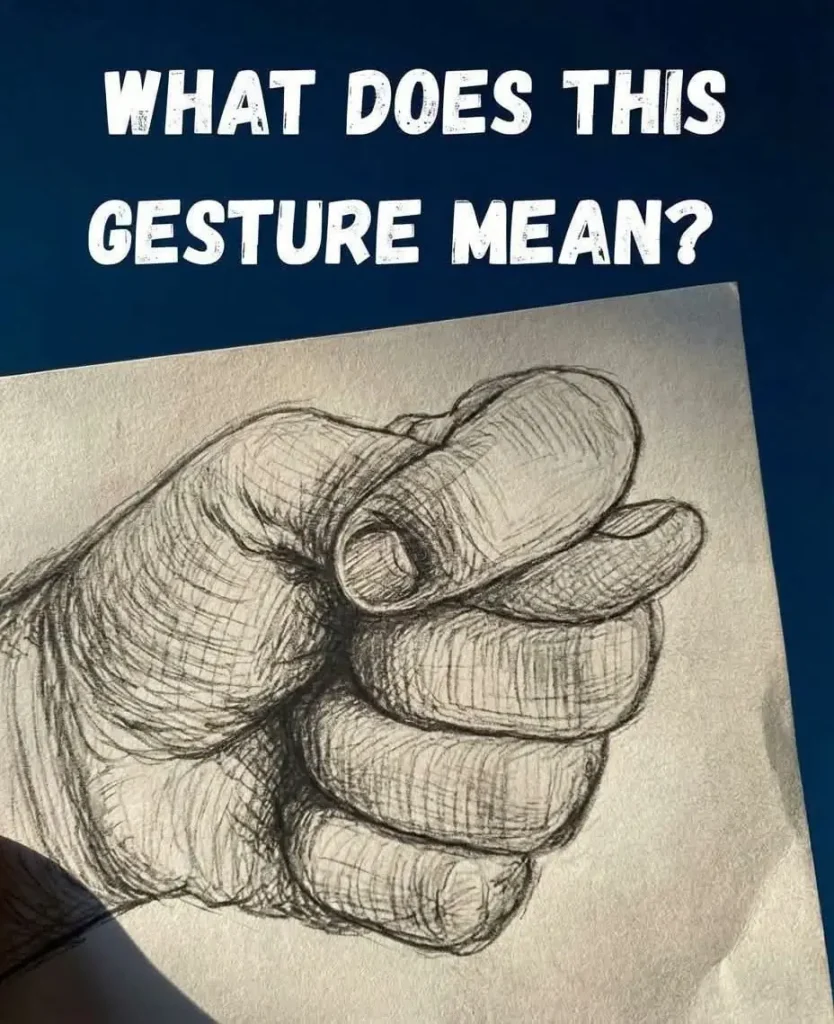
A clenched fist with the thumb tucked between the index and middle fingers: this is the fig gesture, one of the oldest symbolic hand signs in recorded human history. Far from a random movement, it served for centuries as a tool for social communication, protection, and even family bonding. Its story stretches from ancient nonverbal codes to 19th-century European drawing rooms and intimate family farewells.

In brief
- —Thumb tucked between two fingers: the fig gesture explained
- —Used in 19th-century Europe to refuse requests discreetly
- —Also a protective charm in several cultural traditions
A thumb between two fingers: what makes this gesture unique
At first glance, the fig gesture looks like an ordinary clenched fist. The distinguishing detail is subtle: the thumb is tucked between the index and middle fingers rather than resting on top.
Before literacy: how gestures functioned as a full language
Long before texting, emojis, or widespread literacy, nonverbal communication carried much of the social weight that written language now handles. A single hand sign could express disagreement, refusal, humor, or mild defiance — without triggering open conflict.

The fig gesture was precisely that kind of tool. With a quick, discreet motion, a person could politely refuse a request, signal quiet disagreement, or lighten a tense moment with subtle humor — all while maintaining composure and avoiding escalation.
Its effectiveness depended on a shared cultural code. The gesture said nothing to those who did not recognize it, and everything to those who did — a built-in layer of discretion that made it particularly valuable in hierarchical or formal settings.
19th-century Europe: a silent tool for setting boundaries
In parts of 19th-century Europe, where social etiquette and public composure were deeply valued, the fig gesture found a particularly fertile environment. Rather than openly arguing or risking embarrassment, people used it to hold their ground — silently.

It proved especially useful in minor power struggles, when faced with unreasonable requests, or during playful teasing that had gone slightly too far. The gesture allowed someone to push back without breaking the surface calm of a social interaction.
Beyond everyday refusals, the fig gesture also carried deeper symbolic weight in many traditions. The closed fist was associated with inner strength, while the concealed thumb was read as a sign of protection. In some communities, the gesture functioned as a small charm against bad luck, envy, or unwanted attention — used quietly in moments of uncertainty or at the point of farewell.
From social code to family ritual: the gesture’s softer legacy
Over time, the fig gesture shed much of its confrontational edge and migrated into the warmer territory of family life. It became something playful, familiar, and even affectionate — passed down from elders to children through jokes and shared games.

It surfaced in light teasing, moments of shared laughter, and small rituals that carried meaning precisely because they were understood only within a family or close community.
In more emotionally charged moments — goodbyes at a doorstep or a train station — the gesture took on yet another register, serving as a quiet form of reassurance when words felt insufficient. That capacity to shift meaning across contexts, from defiance to protection to tenderness, is what has kept the fig gesture alive in cultural memory long after the social codes that first shaped it have faded.Whether the fig gesture will see any revival in an era dominated by digital communication remains an open question. What historians and cultural anthropologists continue to examine is how gestures like this one encode social values — boundary-setting, protection, humor — that no single emoji has yet managed to fully replace. The gesture’s trajectory from public defiance to private family ritual also raises broader questions about how symbolic practices migrate and transform as the societies that created them change.