
These are the first symptoms of a… See more ♪
A Soft Bluish Lump Under the Tongue? Here’s What It Could Mean – 7 Important Signs You Should Never Ignore
A small bluish lump beneath your tongue may look harmless, but its appearance could reveal something happening inside your salivary glands. Learn what causes this unusual swelling, when it may disappear on its own, and which warning signs mean you should see a doctor.
Imagine brushing your teeth one morning, looking into the mirror, and noticing something you have never seen before: a small, soft, bluish swelling underneath your tongue.
At first, you might assume it is simply a minor irritation. Perhaps you accidentally bit the area while eating, burned your mouth with hot food, or developed a small blister that will disappear within a few days.
But then you look again.
The swelling has a slightly transparent appearance. It seems to sit beneath the surface of the tongue, almost like a tiny bubble filled with fluid. It does not necessarily hurt, but its unusual blue color makes you wonder whether something more serious is happening.
Could it be an ordinary mouth cyst? Is a salivary gland blocked? Could the swelling affect your ability to eat, speak, or swallow?
These are reasonable questions, especially because the underside of the tongue is an area that many people rarely examine closely.
One possible explanation is a condition called a ranula, a type of mucus-filled cyst associated with the salivary glands beneath the tongue. Although the name may sound unfamiliar, ranulas are recognized oral conditions, and many are benign.
However, not every bluish lump beneath the tongue is a ranula.
Other conditions can produce similar-looking changes, and some require medical attention. The location, size, texture, duration, and accompanying symptoms all matter when determining what might be happening.
The most important thing is not to panic when you notice an unusual swelling, but not to ignore it either.
A small lump that initially causes no discomfort may gradually become larger. In some cases, it can interfere with eating, speaking, or swallowing. In other situations, a similar-looking swelling may have a completely different explanation.
Understanding the possibilities can help you recognize when observation is reasonable and when professional examination is necessary.
And one detail deserves particular attention: the bluish appearance may provide a clue, but color alone cannot tell you exactly what the lump is.
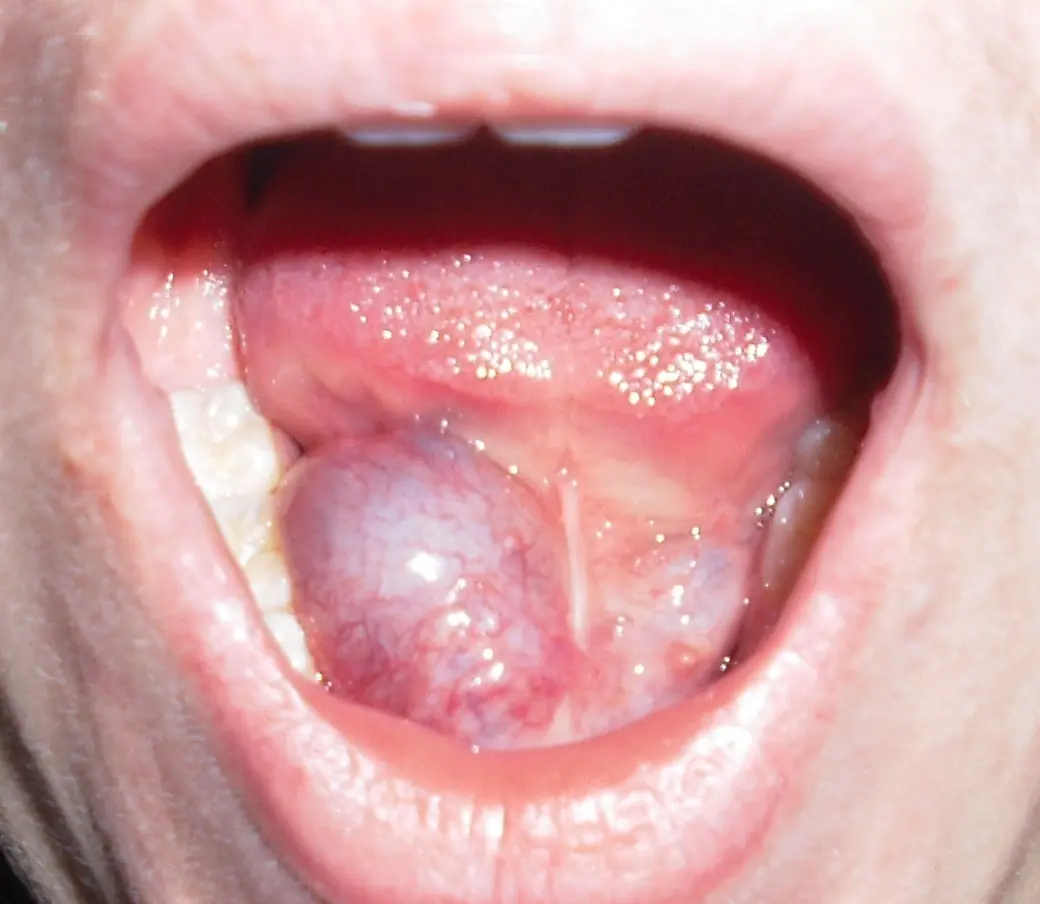
What Could a Soft Bluish Lump Under the Tongue Be?
One of the conditions commonly associated with a soft, fluid-filled swelling beneath the tongue is a ranula.
A ranula is a mucus-filled collection that develops when saliva escapes from a salivary gland or its duct and accumulates in the surrounding tissues.
The name is derived from the Latin word rana, meaning frog. This refers to the appearance of some ranulas, which can resemble the translucent underside of a frog.
Most ranulas develop in the floor of the mouth, beneath the tongue, and are associated with the sublingual salivary gland.
These glands produce saliva that helps lubricate the mouth, begin the digestive process, and make speaking and swallowing easier.
When a salivary duct becomes damaged or blocked, saliva may not flow normally. Instead, mucus can collect in nearby tissues, creating a soft swelling.
A typical ranula may appear:
- Soft and rounded.
- Bluish or translucent.
- Located beneath one side of the tongue.
- Filled with mucus rather than solid tissue.
- Painless or associated with mild discomfort.
The swelling may remain relatively small for some time, or it may gradually increase in size.
Some people discover it accidentally while brushing their teeth or examining their mouths. Others notice it when their tongue touches an unusual bump during eating or speaking.
Although a ranula is generally a benign condition, its size and location can influence how much discomfort it causes.
A small lesion may produce very few symptoms. A larger one may push against the tongue, create a feeling of fullness, or make certain mouth movements uncomfortable.
It is important to remember that a visual description is not enough to diagnose a ranula. A dentist, oral medicine specialist, or oral and maxillofacial surgeon may need to examine the area before determining the cause.
7 Important Signs That May Accompany a Lump Under the Tongue
Not every person with a ranula experiences the same symptoms.
Some people notice only a small swelling, while others develop a larger cyst that gradually changes the way their tongue rests inside the mouth.
The symptoms may also change over time as saliva accumulates or drains from the affected area.
Here are seven signs worth understanding.
1. A Soft, Rounded Swelling Beneath the Tongue
The most recognizable feature of a ranula is a smooth, rounded swelling on the floor of the mouth.
It may look like a small bubble beneath the tongue, with a thin covering of tissue stretched over the fluid-filled area.
The swelling can feel soft or fluctuant when examined by a healthcare professional.
Unlike a hard growth, a fluid-filled cyst may feel as though it contains liquid beneath the surface.
However, people should not repeatedly press or squeeze the lump to determine its consistency.
Doing so may irritate the surrounding tissue, cause discomfort, or damage the lesion.
A dentist or oral specialist can assess its texture safely during an examination.
2. A Bluish or Transparent Appearance
A bluish color is one of the features commonly associated with a superficial ranula.
The swelling may appear translucent because the tissue covering it is relatively thin, allowing the underlying fluid and blood vessels to influence its appearance.
Some lesions look pale blue, while others appear slightly purple or almost transparent.
The exact appearance can vary depending on the depth and size of the swelling.
It is important to understand that blue coloration does not confirm a ranula.
Blood-filled vascular lesions, bruising, and other conditions may also create bluish changes in oral tissue.
A professional examination is needed to distinguish between these possibilities.
3. A Feeling of Fullness Beneath the Tongue
A person may not experience pain but may still feel that something is occupying space underneath the tongue.
This sensation can become more noticeable while eating, drinking, or moving the tongue from side to side.
A small swelling may create only mild awareness.
As it becomes larger, however, the person may feel pressure against the lower surface of the tongue.
This is one reason why a painless lump should not automatically be ignored.
The absence of pain does not necessarily mean that the swelling is unimportant.
4. Difficulty Moving the Tongue Normally
The tongue is involved in speaking, chewing, swallowing, and moving food around the mouth.
A larger swelling beneath it may interfere with these normal movements.
Some people may notice that their tongue feels restricted or is being pushed slightly upward.
Others may find certain movements uncomfortable.
If the swelling becomes substantial, it may affect pronunciation and make ordinary conversations more difficult.
A person may also notice that the tongue does not rest in its usual position.
These changes deserve professional assessment rather than attempts to manipulate the swelling at home.
5. Changes in Eating and Chewing
A swelling beneath the tongue can become particularly noticeable during meals.
The tongue helps position food between the teeth and move it toward the back of the mouth for swallowing.
When a cyst occupies space beneath the tongue, these movements may become less comfortable.
A person may chew more slowly, avoid certain textures, or experience discomfort when moving food around the mouth.
In some cases, the swelling itself may become more noticeable after eating because saliva production increases during meals.
This does not necessarily mean that food is causing the cyst.
It may simply make an existing salivary gland problem more noticeable.
6. Swelling That Changes in Size
One unusual feature of some ranulas is that their size may fluctuate.
The swelling can become larger as saliva accumulates and smaller when fluid drains.
This can create the impression that the problem has disappeared.
However, the cyst may fill again.
A person who notices repeated changes in the size of a lump should not assume that it has permanently resolved.
Keeping track of when the swelling changes may provide useful information for a dentist or doctor.
For example, it may be helpful to mention whether the swelling becomes more noticeable during meals or whether it has gradually increased over several weeks.
7. Difficulty Swallowing or Breathing When the Swelling Becomes Large
This is the warning sign that deserves the greatest attention.
Most small oral ranulas do not cause serious breathing problems.
However, a large ranula can push the tongue upward or extend into deeper tissues beneath the jaw and neck.
In unusual cases, the swelling may interfere with swallowing or narrow the airway.
Difficulty breathing, inability to swallow saliva, rapidly increasing swelling, or a sensation that the throat is becoming obstructed should be treated as an emergency.
Do not wait for a routine dental appointment if breathing is affected.
Seek emergency medical assistance immediately.
The Cleveland Clinic and MedlinePlus both describe the possibility of larger ranulas interfering with swallowing and breathing.
Other Conditions That Can Look Like a Ranula
Although a ranula is an important possibility, it is not the only explanation for a lump beneath the tongue.
The appearance of oral tissue can be misleading, particularly when a swelling is small or located in an area that is difficult to examine.
Several different conditions may produce a bump, cyst, or change in color.
Oral Mucocele
A mucocele is a mucus-filled cyst that develops when saliva from a small salivary gland becomes trapped in surrounding tissue.
It commonly appears on the inside of the lower lip, although it can also develop in other parts of the mouth.
A mucocele may look like a smooth, rounded, transparent, bluish, or pink swelling.
It is often painless.
Some mucoceles develop after accidental trauma, such as biting the lip or repeatedly irritating the same area.
The difference between a mucocele and a ranula is largely related to location and the salivary gland involved.
A ranula specifically develops in the floor of the mouth and is associated with the sublingual salivary gland.
A small mucocele may rupture spontaneously and later disappear, although some return.
It is important not to deliberately puncture one.
Salivary Gland Stones
Another possibility is a salivary gland stone, medically known as sialolithiasis.
These are small mineral deposits that form inside a salivary gland or its duct.
They can block the normal movement of saliva and cause swelling.
Most salivary gland stones occur in the submandibular glands, which produce saliva beneath the jaw and drain through ducts that open under the tongue.
Unlike a typical soft ranula, a salivary stone is usually hard.
Some are white and may be visible beneath the tongue.
One particularly important clue is the relationship between symptoms and eating.
When a person starts eating, the salivary glands produce more saliva.
If a duct is blocked, saliva may accumulate behind the obstruction, producing pain and swelling.
The discomfort may become especially noticeable during meals and then improve afterward.
According to the NHS, salivary gland stones may cause recurring swelling, dull pain, and infection. Severe pain during meals can indicate that a duct is completely blocked.
Small stones sometimes pass naturally, while others require medical removal.
People should never attempt to remove a suspected stone with a needle, toothpick, blade, or another sharp object.
This can cause injury and introduce infection.
Local Irritation or Minor Injury
The underside of the tongue is delicate.
Accidental biting, sharp food, dental appliances, and irritation from nearby teeth can sometimes produce localized swelling.
A small injury may cause temporary redness, tenderness, or a blister-like appearance.
Minor irritation generally improves as the tissue heals.
However, a swelling that continues to grow, repeatedly returns, or remains unexplained should be examined.
People sometimes assume that every mouth lump is the result of biting or accidentally scratching the tissue.
That assumption can delay the identification of other conditions.
Inflammation of a Salivary Gland
Salivary glands can become inflamed because of infection, obstruction, or other medical conditions.
Inflammation may cause swelling, tenderness, pain, and difficulty producing or releasing saliva.
Depending on the affected gland, the swelling may be noticed beneath the tongue, under the jaw, or around the cheek.
If an infection develops, additional symptoms may include fever, redness, and sometimes pus around the affected duct.
These signs deserve medical assessment.
Vascular Lesions
Some lesions beneath the tongue contain blood vessels rather than accumulated saliva.
These may appear blue, purple, or reddish.
Because blood vessels can create a similar visual appearance to a ranula, color alone is not enough to distinguish the two.
A healthcare professional may need to examine the lesion and use imaging, including Doppler ultrasound when appropriate, to assess its nature.
People should not squeeze, puncture, or attempt to drain an unexplained bluish swelling.
Other Cysts and Oral Growths
The floor of the mouth contains several types of tissue, glands, ducts, muscles, and blood vessels.
Different abnormalities can develop in this area.
Some are benign cysts, while others require more extensive investigation.
A dermoid cyst, for example, may develop in the floor of the mouth and create a swelling that gradually becomes larger.
Other less common conditions can also resemble a ranula.
This is why clinicians consider the location, texture, movement, medical history, and imaging findings before making a diagnosis.
A person should not attempt to identify a lump solely by comparing it with photographs found online.
When Is a Bluish Lump Likely to Be Less Concerning?
Not every unusual oral swelling represents a serious disease.
Some small mucus-filled cysts remain relatively stable, painless, and limited in size.
Others may resolve without requiring a procedure.
This is one reason why people should avoid assuming the worst when they first notice a small bump beneath the tongue.
However, there is an important distinction between a condition that is generally benign and a particular lump that has been confirmed as benign.
The first is a medical possibility.
The second requires an appropriate examination.
A soft, bluish, painless swelling in the floor of the mouth may resemble a ranula, but a person cannot reliably establish the diagnosis at home.
A clinician may decide that observation is appropriate if the lesion is small, uncomplicated, and consistent with a benign condition.
In other cases, further investigation or treatment may be recommended.
Small Does Not Always Mean Unimportant
Size is only one factor in evaluating an oral lesion.
A small swelling may still require examination if it is growing, changing color, repeatedly bleeding, or accompanied by other symptoms.
Similarly, a larger lesion may be benign but still require treatment because it interferes with normal mouth function.
The most useful questions are:
- How long has the swelling been present?
- Is it becoming larger?
- Does it hurt?
- Does it change during meals?
- Is there any bleeding?
- Does it affect speech or swallowing?
- Is there swelling elsewhere under the jaw or in the neck?
These observations can help a healthcare professional understand the situation.
Why Waiting Indefinitely Is Not a Good Idea
Some people postpone dental appointments because a lump does not hurt.
Others assume that if the swelling becomes smaller, the underlying problem has disappeared.
Both assumptions can be misleading.
An oral cyst may fluctuate in size without resolving permanently.
A salivary gland obstruction may continue to cause symptoms until the blockage is addressed.
And an unrelated oral lesion may require early evaluation even when discomfort is minimal.
The NHS recommends that people seek medical or dental assessment when they notice a lump in the mouth. It also emphasizes that persistent ulcers, red or white patches, unexplained pain, and swallowing or speaking difficulties should not be ignored.
This does not mean that every mouth lump is cancer.
Most such symptoms can have other explanations.
The reason for examination is to identify the actual cause rather than rely on appearance or guesswork.
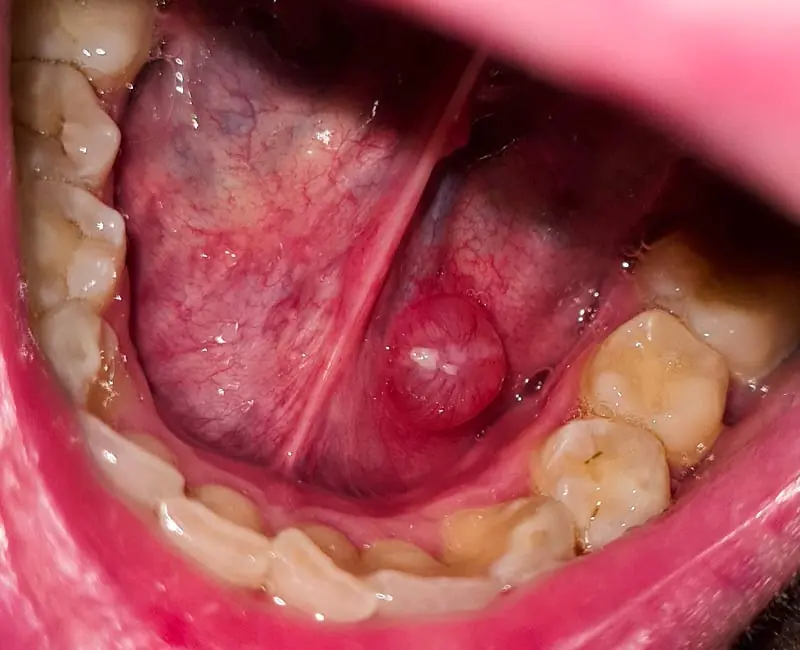
When Should You See a Dentist or Doctor?
One of the biggest mistakes people make with unusual mouth changes is waiting until the swelling becomes painful.
A lump beneath the tongue deserves attention even if it initially causes little discomfort.
A dentist is often a sensible first point of contact because dentists regularly examine the tongue, gums, salivary gland openings, and floor of the mouth.
Depending on the findings, they may recommend an oral medicine specialist, an oral and maxillofacial surgeon, or an ear, nose, and throat (ENT) specialist.
There are several situations in which an appointment should not be delayed.
The Swelling Continues to Grow
A lump that becomes progressively larger should be examined.
Growth may indicate that fluid is accumulating, that a salivary duct remains obstructed, or that another type of lesion is developing.
A growing swelling can eventually interfere with tongue movement and normal oral functions.
Even if it remains painless, an increasing size is a reason to seek professional assessment.
The Lump Keeps Returning
Some mucus-filled cysts may rupture or become smaller before returning.
This can create a misleading impression that the problem has resolved.
If the same swelling repeatedly appears, a clinician may need to investigate the underlying salivary gland or duct.
Repeated swelling should not simply be treated as an ordinary mouth blister.
You Experience Pain or Signs of Infection
Pain, redness, tenderness, pus, or fever may indicate inflammation or infection.
A salivary gland obstruction can sometimes lead to infection around the affected area.
If the swelling becomes increasingly painful or the surrounding tissue looks inflamed, contact a healthcare professional promptly.
A high fever, rapidly spreading swelling, or feeling severely unwell requires urgent assessment.
Eating or Speaking Becomes Difficult
The tongue performs many essential functions.
Even a benign swelling can become troublesome when it occupies space beneath the tongue.
Difficulty chewing, moving food, speaking clearly, or swallowing should not be ignored.
A larger ranula may push the tongue upward and interfere with ordinary movements.
If swallowing becomes difficult, medical assessment is important.
You Notice a Lump in Your Neck
A ranula can sometimes extend beyond the floor of the mouth and create swelling in the neck.
This is known as a plunging ranula.
The swelling may develop beneath the jaw or in the upper neck, sometimes without an obvious large lump inside the mouth.
However, neck swelling has many possible causes.
A doctor may need to distinguish a plunging ranula from enlarged lymph nodes, other cysts, infections, or salivary gland abnormalities.
The Lump Is Hard, Bleeds, or Has an Unusual Surface
A hard or fixed lump, unexplained bleeding, persistent ulceration, or an irregular surface should be examined.
These features do not automatically indicate cancer, but they should not be dismissed.
The NHS lists a lump inside the mouth, persistent ulcers, red or white patches, ongoing pain, and swallowing difficulties among symptoms that deserve medical assessment.
A dental or medical professional can determine whether additional testing or specialist referral is needed.
How Doctors Diagnose a Ranula or Another Oral Swelling
When someone visits a dentist or doctor with a lump beneath the tongue, the first step is usually a detailed examination.
The clinician needs to understand not only what the swelling looks like but also how it developed.
A diagnosis may be relatively straightforward when the location and appearance are typical.
However, some lesions can resemble one another, so additional tests may be necessary.

The Real Reason Why a Man Turns His Back on You When Sleeping: Understanding the Hidden Language of Body Position

Woman caught having …See more

A CHEATING man NEVER leaves his wife because…See more
About The Author
